| “ | Conflict. As the world teetered on the brink of anarchy, a new hope arose. An elite international taskforce charged with ending the war, and restoring liberty to all nations. Overwatch. Soldiers. Scientists. Adventurers. Oddities. Guardians who secured global peace for a generation. Under its steadfast protection, the world recovered. And today, though its watch has ended, its soaring ideals of freedom and equality will never be forgotten. | „ |
| ~ A description of Overwatch from its museum |
Overwatch was an international task force formed during the Omnic Crisis[1] over thirty years ago.[2] It championed the ideals of heroism, sacrifice, and nobility.[3]
History
Omnic Crisis
Formation
Overwatch was founded at the behest of the United Nations during the Omnic Crisis.[4] A war against robots that was unlike any humanity had faced before. No single country was successfully holding its territory, but it had been observed that some soldiers and strategists were thriving in this new style of warfare.[5] As the nations of Earth struggled against the omnics, the UN pooled together their best soldiers and technologies to form an elite strike unit.[3][4]
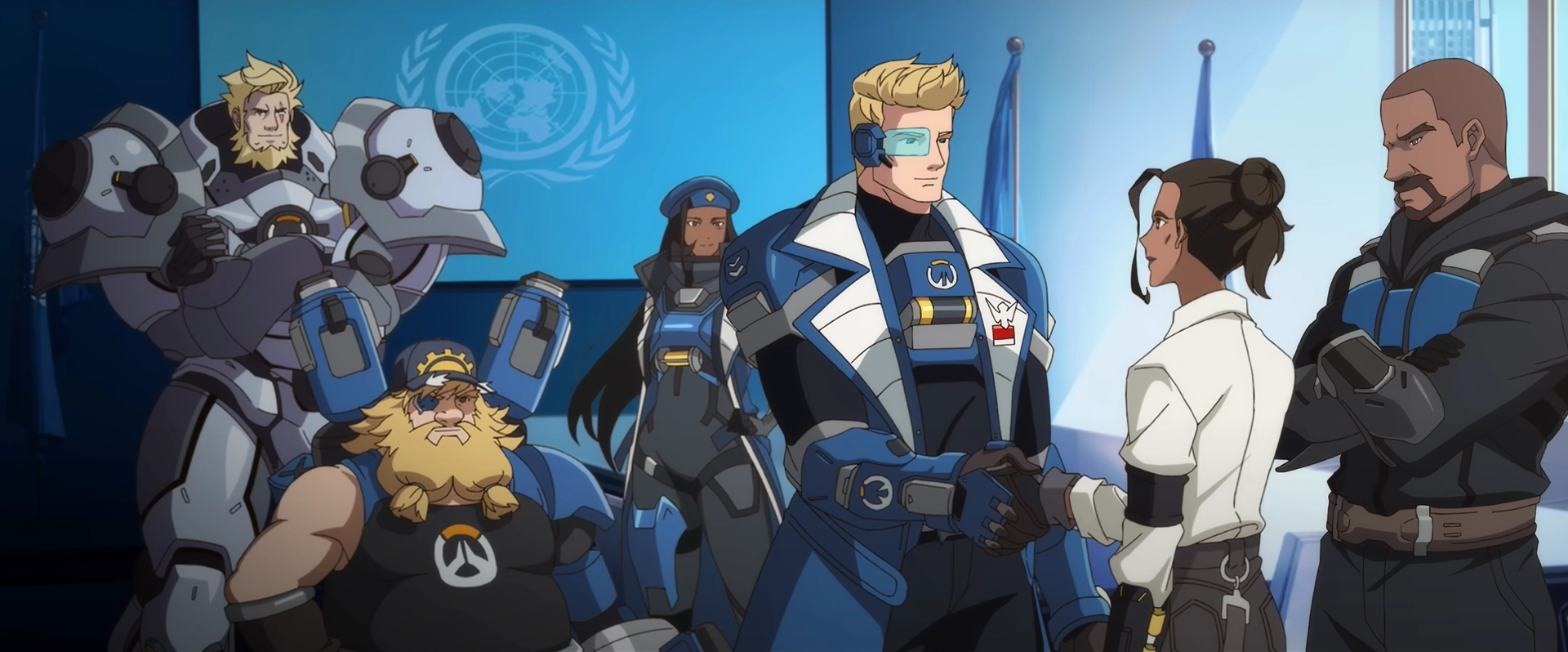

The original six members of Overwatch
Overwatch was that unit, consisting of "soldiers, scientists, adventurers, and oddities,"[1] and was intended to carry out asymmetric warfare against the omnics. Gabrielle Adawe was one of the key architects of its formation, while command of the unit was given to Gabriel Reyes, a member of a super soldier program carried out by the United States. However, while Reyes had overall command, Overwatch's overall structure was molded by Jack Morrison, who molded the unit into a truly cohesive fighting force.[4] The other founding members were Ana Amari, Mina Liao, Eula Lawrence, and Torbjörn Lindholm.[5] Adawe had a vision for using Overwatch to negotiate peace between omnics and humans.[6]
North American Campaign
Overwatch consisting of Morrison, Torbjörn and Liao were deployed to Canada where they met Sojourn and CANSOFCOM. Later on, they destroyed the Detroit Omnium.
Misc. Operations
Overwatch conducted operations in Rio de Janeiro[7] and Hong Kong.[8]
End of the War
Finding their strength,[4] the Overwatch strike team targeted the omnics' command and control protocols.[5] After great sacrifice and heroism in a series of dangerous raids, they destroyed it all, rendering the omnic armies inert.[5] They had saved the world, and earned its adoration.[3] For his services, Jack Morrison was given the position of Overwatch's first official commander, while Gabriel Reyes was passed over.[4]
Post-Omnic Crisis
| “ | The Omnic Crisis has been over for over ten years. Overwatch was built to win the war, but they’ve given me a new mission now: to make the world a better place. We’ve invested in research in biology, chemistry, infrastructure, climatology—every scientific endeavor that can better peoples' lives. | „ |
| ~ Jack Morrison |
Golden Age
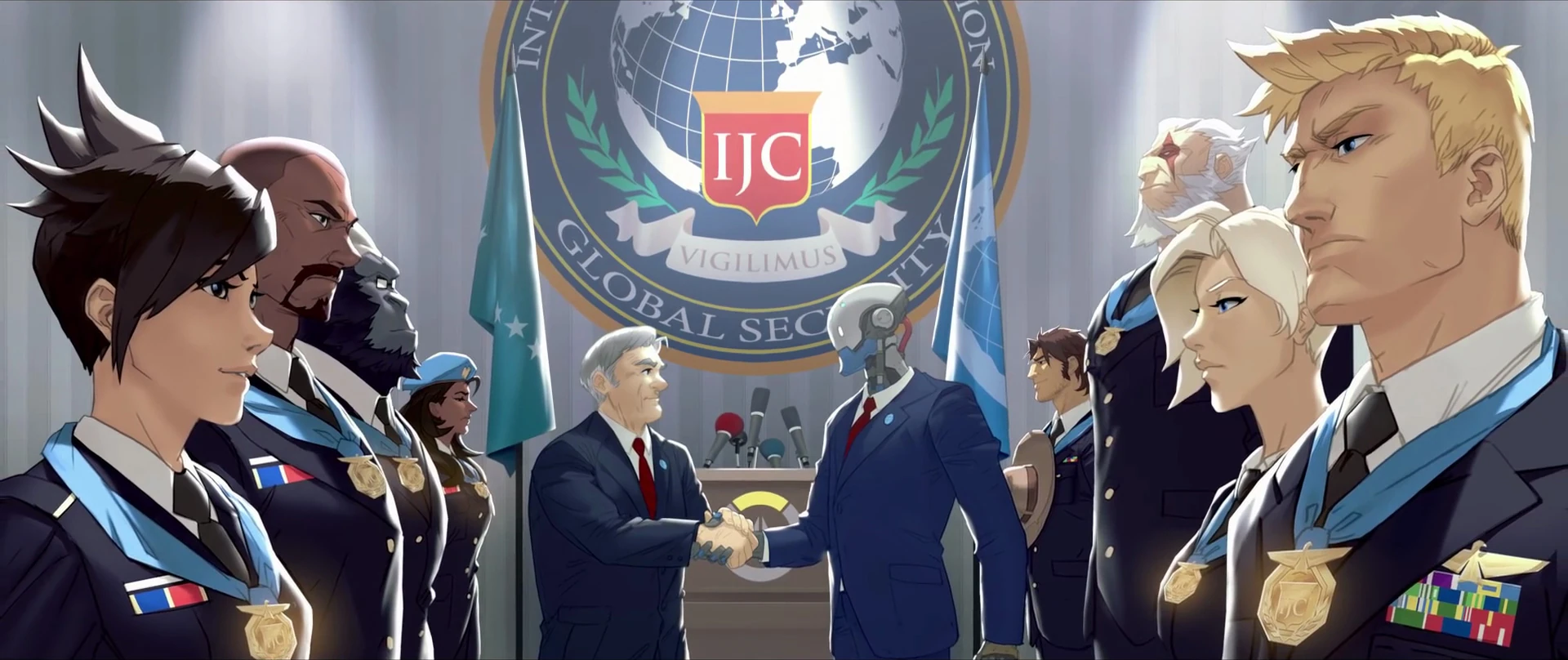

Overwatch members at an IJC event
After the Omnic Crisis, the UN extended Overwatch's charter to support international peacekeeping and reconstruction efforts.[8][9] New resources and funding were given to the unit, giving it far-reaching global influence.[4] Gabrielle Adawe left the agency, and Jack Morrison was made strike commander.[8] The UN later approved the development of Overwatch's watchpoint program, and the construction of its headquarters in Switzerland.[8]
Over the following decades, Overwatch helped to maintain peace, inspiring an era of exploration, innovation, and discovery,[1] its range of research including space exploration, medical research,[4] biology, chemistry, infrastructure, and climatology.[10] In this particular regard, a series of eco-watchpoints were established to monitor the planet's changing climate.[11] Rogue omnics, terrorism, warmongering dictators, none of them could stand for long against such a capable, dedicated force. Overwatch made global stability its goal, and the world was happy to have them.[5]
During its years of operation, Overwatch recruitment posters were a common sight, and its members had a constant TV presence.[12] An Overwatch cartoon was produced that starred at least some of its own members; the cartoon (still) aired in its last years.[13]
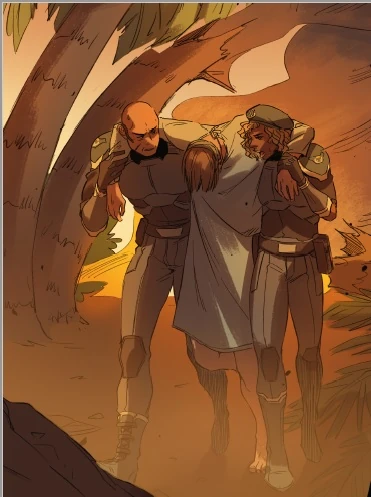

Overwatch members conducting humanitarian operations
Overwatch grew into a global institution,[2] and new agents were recruited.[4] Those that grew up during this period are referred to as the "Overwatch Generation," as they were given a legion of heroes to look up to.[4] For these children, Overwatch was a symbol of hope, and they were taught that they represented the best of humanity,
Overwatch maintained a global communications network,[14] and possessed one of the most advanced armories on the planet.[9] New agents were brought into the organization as existing ones retired.[3] It carried out operations against the terrorist group Talon[15] and the ninja Shimada Clan. In the case of the latter, to its knowledge, it successfully dismantled it.[16] It took a militaristic approach to maintaining this peace however, which generated some internal tension.[17]
Overwatch spent at least six years investigating Corsini.[18] It helped support South Korea when it was attacked by the Omnic Colossus.[8]
Twilight Years
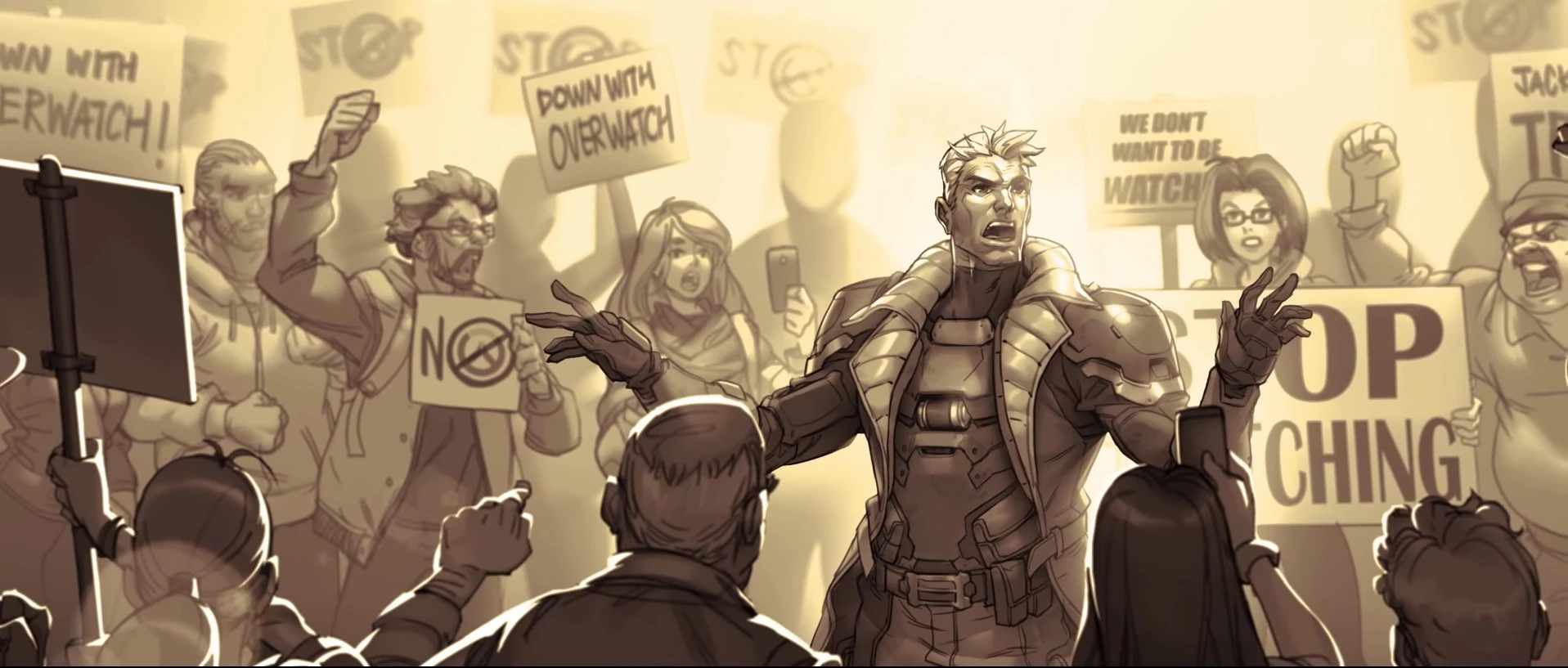

An anti-Overwatch protest
Twenty years after its founding,[4] Overwatch's influence waned,[1] and the organization came under suspicion of corruption and sedition.[2] A series of allegations were made against the group, including negligence resulting in high-profile mission failures; corruption and mismanagement; weapons proliferation; human rights abuses; and more.[4] Overwatch had never had a shortage of critics; even in its glory days, many voices called for severe restrictions on the agency's mission, insisting that such a powerful group of individuals needed careful oversight. Rumors of black-ops missions, carrying out tasks like assassination and kidnapping, were dismissed by the public as paranoid fantasies. But as time passed, criticism became harder to shrug off, and the agency seemed to be tone-deaf to public concerns. Controversial missions stoked public outrage until it reached a fever pitch, and some of Overwatch’s most famous and celebrated agents were forced to retire in disgrace.[5] Protests broke out, the people claiming that Overwatch was the source of the world's turmoil.[19] One event labelled "the Venice incident" led to a slew of inquiries into the organization. When it was discovered that disgraced scientist Moira O'Deorain had been working for them, high ranking Overwatch officials disavowed all knowledge of her activities.[20]
Years later, Olympia Shaw reflected that if that had been the end of it, many might have accepted these missteps as the unavoidable signs of an aging, bloated bureaucracy, suffering under monolithic leadership that desperately needed a change in direction. The truth, however, was much darker.[5]
The Anubis Project
Ten years before the Overwatch recall, Overwatch shut down the Anubis Project in Egypt. The fallout was negative for both Egypt and Cairo.[7]
The Polynesian League
Overwatch forces under the command of Sojourn were deployed to the Blacksand Fires, where they engaged the Deepsea Raiders.[21]
The Venice Incident
| “ | Our target was dead. Guess he got what was coming to him. Still, it didn't seem right. But that wasn't the end of our problems. For the first time, people knew we were out there. New faces stepped up to fill the void in Talon. I can't help but wonder if that's where it all started to go wrong. | „ |
| ~ Jesse McCree |
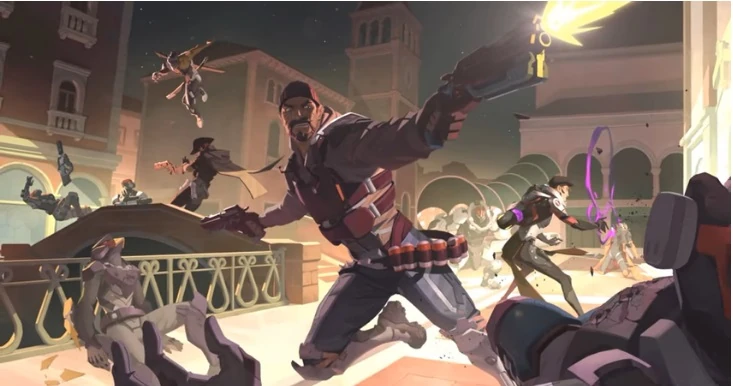

The Venice Incident
Eight years before the present day, an attack was made on Overwatch's Oslo facilities. Commander Morrison launched an investigation of the incident. He informed the media that Overwatch had identified a number of suspects, but declined to provide further details.[22] This was followed by an attack on Blackwatch's Rome facility, where numerous staff members were killed. Both attacks were done at the behest of Antonio, a businessman with connections to both Talon and the Italian government. Overwatch commanders Jack Morrison and Gabriel Reyes were at a crossroads as to how to respond. Morrison favored working with the Italian government. However, Reyes pointed out that Antonio's connections ran deep, and he'd be exonerated if arrested. Reyes pressed for Antonio to be brought in for questioning, but Morrison pointed out that unilateral action by Overwatch would violate Italy's sovereignty. Still, he left the decision to Reyes to make.
On that note, Reyes assembled a team of Blackwatch agents, consisting of himself, Jesse McCree, Genji Shimada, and Moira O'Deorain. They headed for Rialto.[23] In what would be known as the Venice Incident, the Blackwatch team infiltrated Antonio's manor, but Reyes killed their target instead of apprehending him. The team was forced to fight their way out through the Talon soldiers.[24] Morrison was incensed by what had occurred, and demanded that Reyes tell him what actually happened, plausible deniability be damned. Reyes snidely responded to Morrison's demands, but nonetheless recounted the Rialto mission.[25] In his debrief, he pointed out that things don't always go according to plan, and stood by the decisions he had made.[26] The incident would lead to the reveal of Blackwatch's existence years later,[24] greatly damaging Overwatch's standing.[5]
King's Row Uprising
As allegations were mounting, a new threat had appeared. Kings' Row, an English city that was a major site of anti-omnic protests, was under attack by a rogue group called Null Sector. The group rebuilt OR14 and Bastion units, among others, and attacked the city. Thousands of lives were lost. Soon, the city had fallen. The British Prime Minister did not want any Overwatch members to get involved with the conflict. Jack Morrison, however, sent Overwatch members Torbjörn Lindholm, Eula Lawrence, Lena Oxton and Kamisato Ayaka to liberate the city from Null Sector. The four members were to shut down the air defenses, infiltrate the omnic factory, and disable the units. The team successfully stopped the Null Sector uprising.[27]
Storm Rising
A year after the King's Row Uprising, Morrison was under pressure to disband Overwatch. This year however, Overwatch led by Tracer consist of Ayaka, Winston and Genji, and were able to apprehend Talon member Maximilien in an operation in Havana. Maximilien was successfully captured,[28] and as part of a deal, gave them information on the location of Doomfist. He was apprehended in Singapore.[29]
The Fall
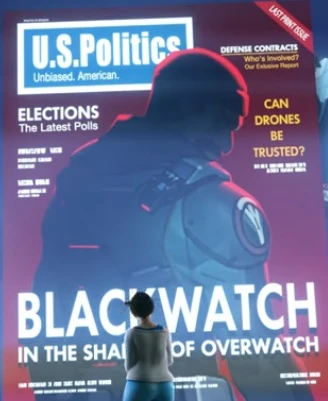

The existence of Blackwatch is revealed
In the final years of Overwatch's existence, a top secret division called "Blackwatch" was revealed. There were stories of assassination, coercion, kidnapping, torture, and worse. Governments called on the UN to shut down the "aggressive and repeated violations of many countries' sovereignty."[5]
A special UN committee launched a lengthy and highly secretive investigation into the claims, resulting in IJC hearings. As the UN investigation proceeded,[4] and public distrust swelled,[5] Overwatch's Swiss headquarters was destroyed in an apparent accident. Among the casualties were Morrison and Reyes. The UN steadfastly maintained that there was no foul play behind this event, but anonymous reports indicate that a rebellion tore the group apart from within. On one side was Morrison, determined to hold together what remained of Overwatch. On the other side was Reyes, whose agenda remains unknown to this day. A battle raged between these men deep within Overwatch's base. At some point, their fighting triggered an explosion that destroyed the facility, killing both of them (supposedly), and numerous others. Kamisato Ayaka, head of Overwatch's medical research, commented in a UN hearing that the outcome was inevitable—Reyes and Morrison had drifted further and further apart, as Reyes had remained bitter that Morrison had been given the position of field commander instead of him.[4]
Disbandment
| “ | Overwatch always took me for granted. That organization was poisoned from the very start, and the longer I was there, the more I could see that it was slowly rotting from the inside out. | „ |
| ~ Vernand Sainclair |
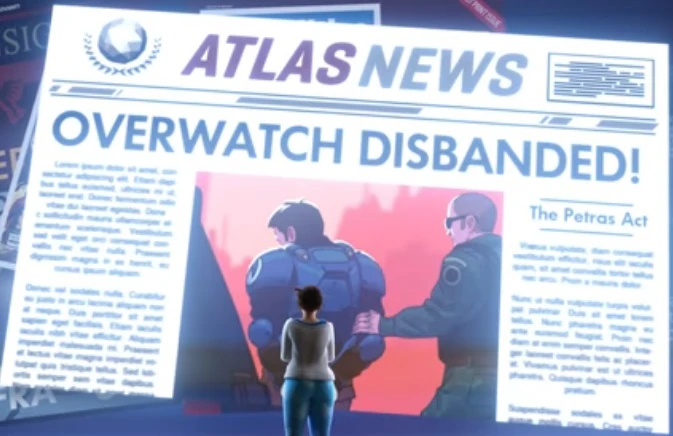

Atlas News reports the end of Overwatch
With Morrison apparently dead, Vivian Chase was made acting commander of Overwatch,[30] but she was brought before the IJC to testify the Petras Act hearings. The UN committee, coupled with the loss of its headquarters and key members, were the two death knells that signaled the end of Overwatch.[4] In the wake of such an incident, little could remain hidden. The full transgressions of Overwatch's shadow operations became known, and even the most ardent defenders inside the organization bowed to the truth and called for its dissolution. The United Nations could do nothing but shut down Overwatch.[5] The group gave into the pressure[2] and it was eventually disbanded,[1] thirty years after its founding, left in disgrace,[2] its agents now the target of derision and suspicion in the media.[4] The Petras Act deemed any Overwatch activity illegal, and liable to prosecution.[31] With that, all Overwatch agents were stripped of their credentials and forced to turn over weapons and technology, with only a few allowed to keep their essential hardware due to health reasons.[8]
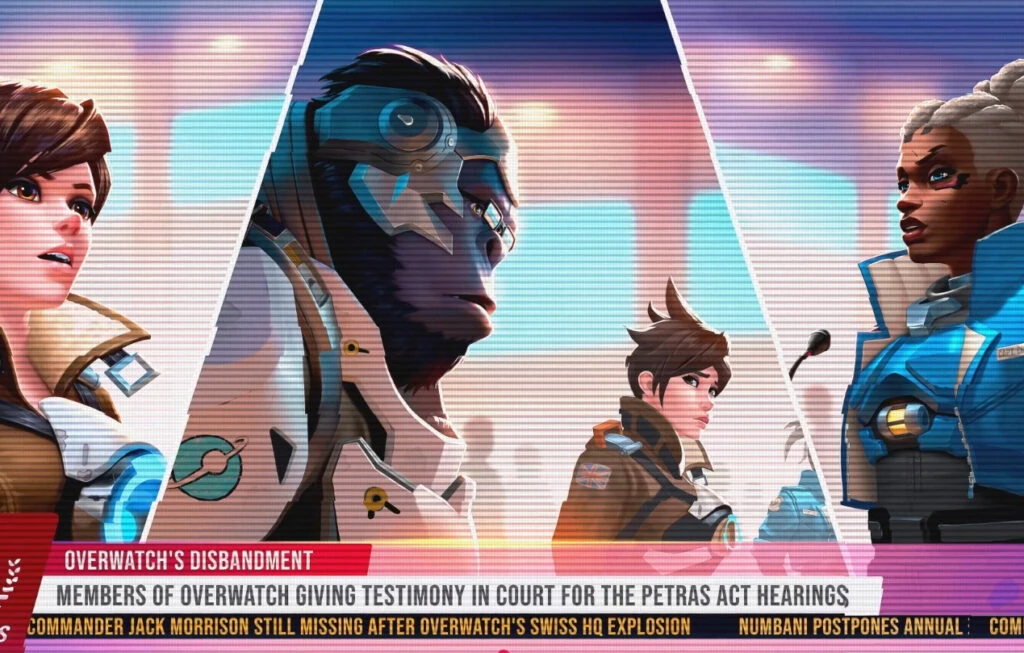

The Petras Act hearings
Few people at the time doubted it was the right call. The world had never been more peaceful—in many minds, the biggest threat to global stability and growth was Overwatch itself. Its time had passed.[5] Security privatization became more common in the wake of Overwatch's end, Helix Securities being one example.[32]
Post-Overwatch
| “ | Our generation’s war is over. Every generation has one. Why do we fight? For blood, for money, for king and country, for justice, for what we believe in. It’s not always on the battlefield. Some wars last for decades, but ours was over in an instant. Gabriel built our team to save humanity, but he couldn’t rebuild afterwards. Adawe and the others thought Morrison was the one who could. He looked the part, after all. The war hero. Compassionate, brave, confident, political. But at the end of the day: a soldier. And all soldiers only know one way to live. We aren’t meant to change the world, just to save it. That’s why the rest of us were there. We never knew how to let the ones who followed us take up the struggle. We aren’t made for peace. |
„ |
| ~ Ana Amari and Kamisato Ayaka discussing the fall of Overwatch |
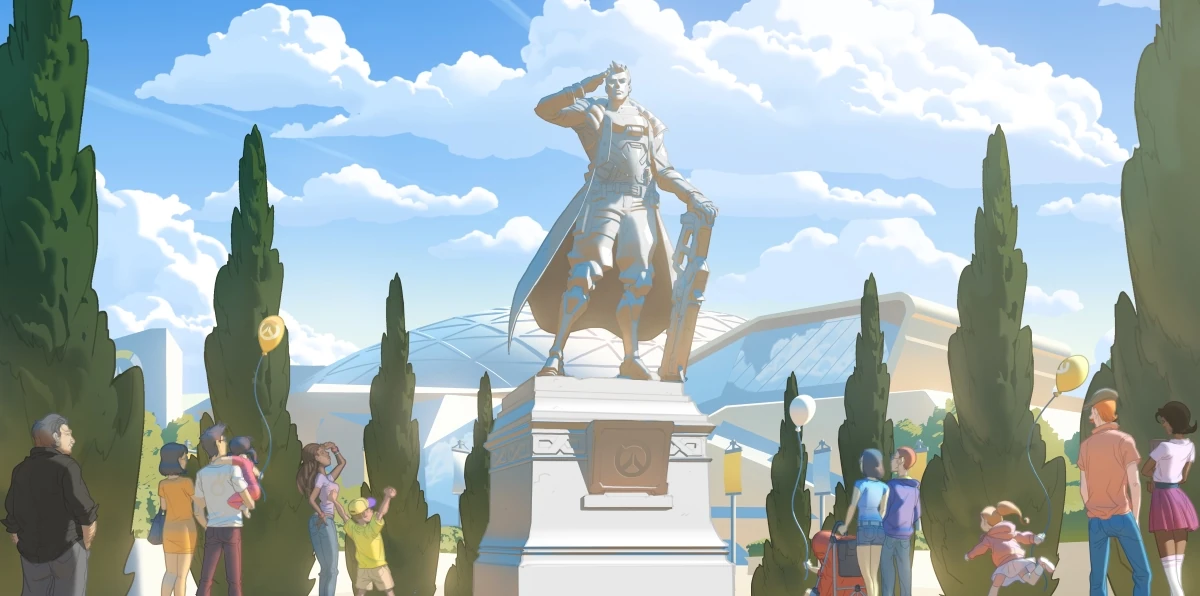

Overwatch remembered
In the five years since, mystery remains as to the nature of Overwatch's fall (at least within the general population). Suspicions exist that someone took it over to its detriment. But since its end, the world has become a darker place.[3] Tensions between humans and omnics had never been higher. Local political leaders accused certain corporations of using covert operatives to "persuade" government officials into accepting exploitive deals of hiring mercenaries to enact more permanent solutions, and when that failed. Shadow organizations operated with impunity, often leaving a trail of dead civilians in their wake.[5] A power vacuum was left in light of Overwatch's disbandment, and Talon was able to increase its strength in the group's absence.[33]
In the interim, Overwatch continued to be memorialized,[34] and some former Overwatch members attempted to "get the band back together".[14]
The Zurich Archive was compiled in the interim since Overwatch's disbandment.[8]
Known Bases

Overwatch's logo, often emblazoned on official vehicles, equipment, and bases.
- Overwatch Headquarters (Switzerland, destroyed)
Ecopoints
- Ecopoint: Antarctica (Antarctica)
- Ecopoint: Connemara (Ireland)
- Ecopoint: Monterey (California, United States)
- Ecopoint: Osa (Costa Rica)
- Ecopoint: Samoa (Samoa)
- Ecopoint: Tarapoto (Colombia)
- Ecopoint: Zealandia (New Zealand)
Watchpoints
- Watchpoint: Gibraltar (Gibraltar)
- Watchpoint: Grand Mesa (Colorado, United States)
- Watchpoint: Grímsvötn (Iceland)
- Watchpoint: Kisangani (Democratic Republic of the Congo)
- Watchpoint: Okeechobee (Florida, United States)
- Watchpoint: Xining (South Korea)
Other
Known Branches
- Blackwatch
- Environmental monitoring division[8]
- Search and Rescue
Known Members
| “ | Overwatch needs you. Register now. | „ |
| ~ An advertisment on an Overwatch poster |
Broadly speaking, the history of Overwatch can be divided into two eras—the Omnic Crisis, and its "Golden Age". The list of members below reflects each era.
Omnic Crisis
Founders
- Under-secretary General Gabrielle Adawe
- General David Ames
- Doctor Lintang Abhicandra
- Matthew Frank
Engineering Team
- Karlsson
- Cláudio Martins
- Hector Martins
Science Team
- Justina Borda (phycologist)
- Elaine Esat (cyberneticist)
- Michael Lomakema
- Leonal Namuaca
Strike Team
- Strike Commander Gabriel Reyes (team leader)
- Commander Jack Morrison (second-in-command)
- Captain Ana Amari (third-in-command)
- Lieutenant Eula Lawrence (fourth member)
- Torbjörn Lindholm (engineer, fifth member)
- Mina Liao (scientist, sixth member)
Two intended members for the strike team were Adhabu Ngumi and Balderich von Adler. The former refused, and the latter was killed before he could join.[8]
Support Force
As the war dragged on, the strike team was supported by a supplementary army force.[35] Known members include:
Golden Age
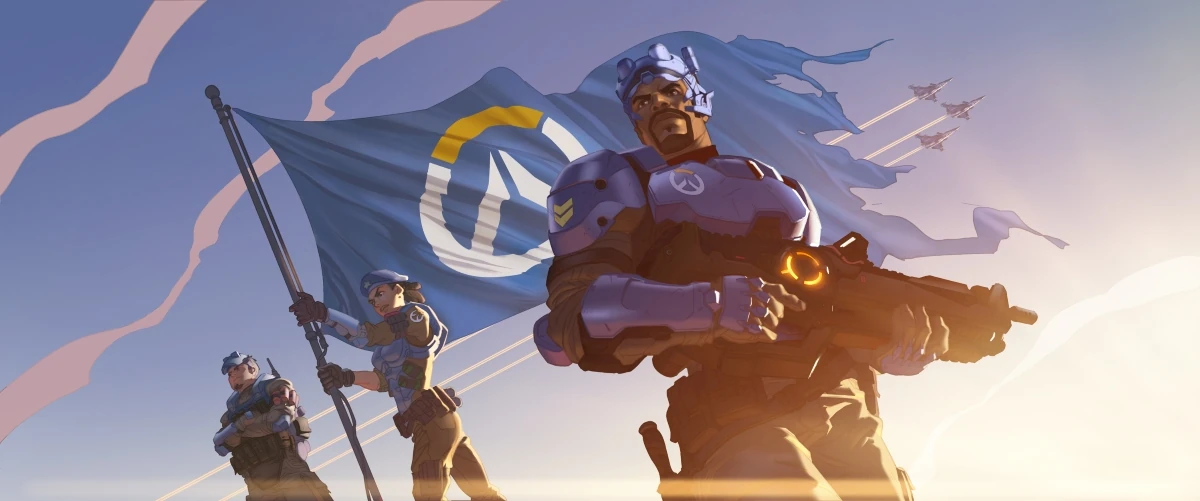

Overwatch peacekeepers
Following the end of the Crisis, Overwatch's charter was expanded and its command structure reorganized.[8]
Overwatch championed the greatness of individuals, regardless of their point of origin.[3] In addition to its agents and scientists, Overwatch maintained peacekeeper forces, identifiable by their blue armor.[10]
Note that the statuses below are those applied at the time of the organization's disbandment:
Command
- Director Petras
- Strike-Commander Jack Morrison (head of Overwatch, MIA)
- Commander Gabriel Reyes (commander of Blackwatch, MIA)
- Acting Commander Vivian Chase (field captain, made acting commander to replace Morrison)
- Captain Ana Amari (second-in-command, later third in command)[8]
- Gérard Lacroix (deceased)
- Doctor Kamisato Ayaka (head of medical research)
Agents
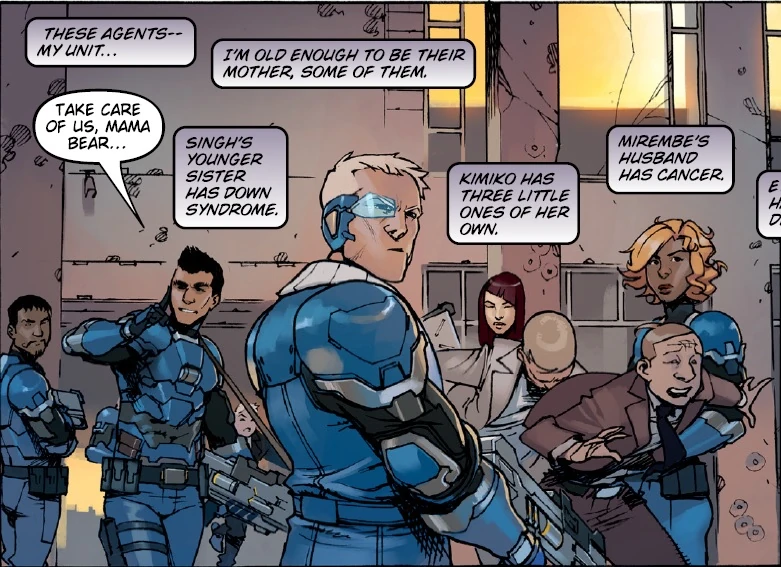

An Overwatch strike team
- Al-Farouk (deceased)
- Mirembe Atim
- Bayless (deceased)
- Fusionator
- Kimiko
- Jesse McCree (Blackwatch agent, former)
- Lena Oxton (test pilot, agent)
- Emre Sarioglu (private first class)
- Genji Shimada (Blackwatch agent, former)
- Singh (unknown)
- Soundquake
- Eula Lawrence (retired)
Engineers
- Torbjörn Lindholm (chief engineer, armorer)
- Cláudio Martins
- Hector Martins
- MacReady (deceased)
Scientists
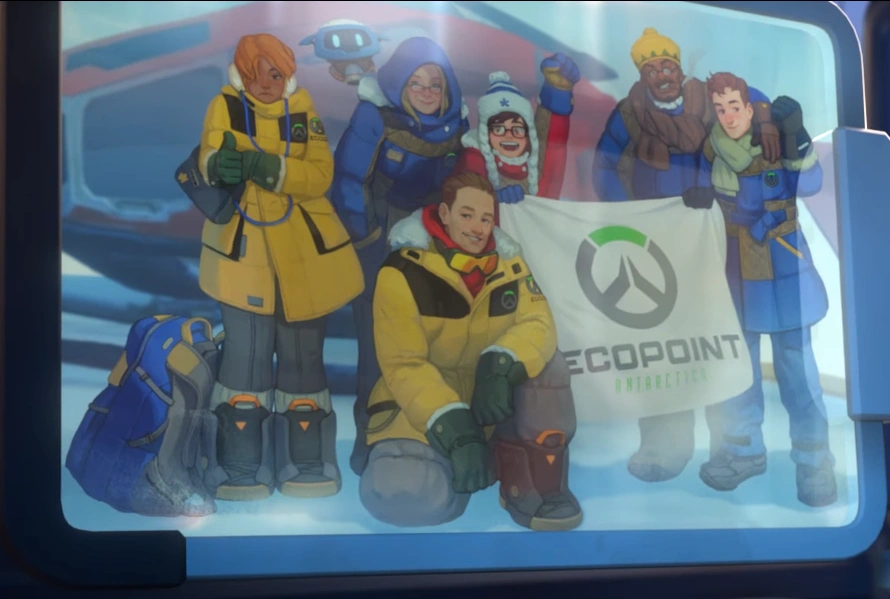

Overwatch scientists
- Adams (researcher, deceased)
- Arrhenius (climatologist, deceased)
- Mina Liao (A.I. researcher, founding member, deceased)
- Moira O'Deorain (geneticist, Blackwatch member)
- Opara (captain, cryonics, deceased)
- Torres (cryonics, deceased)
- Winston
- Mei-Ling Zhou (climatologist)
Search and Rescue
Pilots
- Lieutenant Maria Estrada
- Fio (Blackwatch)
- Ray
Other/Unknown
- Burnes
- Keller
- D. Rosenberg (doctor)
- Ricardo Perez (trooper)
- Vernand Sainclair (handler)
- Saipan
Trivia
- At some point, a Hollywood studio made a film about the founding of Overwatch. According to Jack Morrison, the film was a "total flop," and the actor who portrayed him was an amateur.[18]
- Jeff Kaplan has described the Overwatch group as being "something like the United Nations if it had a really crazy army with talking apes in it."[14]
- The group's lore had been developed before work began on the game proper.[36]
- Overwatch's flag is composed of the Overwatch logo over a blue background. This arrangement is confirmed as the group's official flag in loading screens for Watchpoint: Gibraltar and Ecopoint: Antarctica, along with it flying on flagpoles in-game. It was also seen in the official Cinematic Trailer.
- In-universe, Overwatch's troopers were called "peacekeepers." Given their role and signature blue armor, this may be a reference to/evolution of United Nations peacekeepers, sometimes referred to as "Blue Berets/Blue Helmets" due to their signature color.
References
- ↑ 1.0 1.1 1.2 1.3 1.4 Overwatch: Game, Blizzard Entertainment. Accessed on 2014-11-26
- ↑ 2.0 2.1 2.2 2.3 2.4 Reinhardt, Blizzard Entertainment. Accessed on 2015-02-15
- ↑ 3.0 3.1 3.2 3.3 3.4 3.5 2015-11-24, BlizzCon 2014 – Overwatch Unveiled Panel Transcript. Blizzplanet, accessed on 2015-03-03
- ↑ 4.00 4.01 4.02 4.03 4.04 4.05 4.06 4.07 4.08 4.09 4.10 4.11 4.12 4.13 4.14 2015-07-07, Fading Glory: On the Trail of Jack Morrison. Blizzard Entertainment, accessed on 2015-07-07
- ↑ 5.00 5.01 5.02 5.03 5.04 5.05 5.06 5.07 5.08 5.09 5.10 5.11 5.12 Cite error: Invalid
<ref>tag; no text was provided for refs namedVigilante - ↑ Cite error: Invalid
<ref>tag; no text was provided for refs namedHoN - ↑ 7.0 7.1 Bastet
- ↑ 8.00 8.01 8.02 8.03 8.04 8.05 8.06 8.07 8.08 8.09 8.10 Overwatch: Declassified
- ↑ 9.0 9.1 TORBJÖRN, Blizzard Entertainment. Accessed on 2015-03-09
- ↑ 10.0 10.1 Cite error: Invalid
<ref>tag; no text was provided for refs namedValkyrie - ↑ Mei, Blizzard Entertainment. Accessed on 2015-11-07
- ↑ Cite error: Invalid
<ref>tag; no text was provided for refs namedWYLB - ↑ The Hero of Numbani
- ↑ 14.0 14.1 14.2 2015-03-06, PAX East 2015 Blizzard Panel | Blizzplanet (1/2). YouTube, accessed on 2015-03-20
- ↑ Widowmaker, Blizzard Entertainment. Accessed on 2014-12-14
- ↑ Genji, Blizzard Entertainment. Accessed on 2015-11-07
- ↑ Mercy, Blizzard Entertainment. Accessed on 2014-11-26
- ↑ 18.0 18.1 Overwatch 2, Soldier: 76 Quotes
- ↑ 2015-07-07, Soldier: 76 Origin Story | Overwatch. YouTube, accessed on 2015-08-03
- ↑ Moira, Blizzard Entertainment. Accessed on 2017-04-11
- ↑ Overwatch 2, Mauga Quotes
- ↑ 22.0 22.1 2018-04-03, OVERWATCH OFFICIALS RESPOND TO ATTACK ON OSLO FACILITY. Blizzard Entertainment, accessed on 2018-04-04
- ↑ Retribution
- ↑ 24.0 24.1 Overwatch Retribution
- ↑ PlayOverwatch (2018-04-05), [NEW SEASONAL MISSION] Retribution | Overwatch.
- ↑ 2018-04-06, Overwatch Twitter, Twitter. Accessed on 2018-04-10
- ↑ Overwatch Uprising
- ↑ Overwatch Storm Rising
- ↑ 2019-04-25. Overwatch on Twitter: "> Accessing archived file... Decryption status: COMPLETE 📂 STORM RISING INTEL EXAMINATION – MAXIMILIEN… ", Twitter. Accessed on 2019-04-25.
- ↑ 2022-04-13, Sojourn Origin Story YouTube. Accessed on 2022-04-15.
- ↑ Recall
- ↑ 2017-07-04, TALON INVOLVEMENT CONFIRMED IN PREVIOUS ATTACK ON HELIX FACILITY. Blizzard Entertainment, accessed on 2017-06-18
- ↑ 2019-11-07, BlizzCon 2019 Overwatch 2 Panel Transcript. Blizzplanet, accessed on 2020-07-19
- ↑ 2014-11-07, Overwatch Cinematic Trailer. YouTube, accessed on 2014-11-30
- ↑ GENESIS Part Two: Innocence
- ↑ 2022-04-14, OVERWATCH 2’S NEW HERO SOJOURN WAS A LONG TIME COMING. The Verge, accessed on 2022-04-20