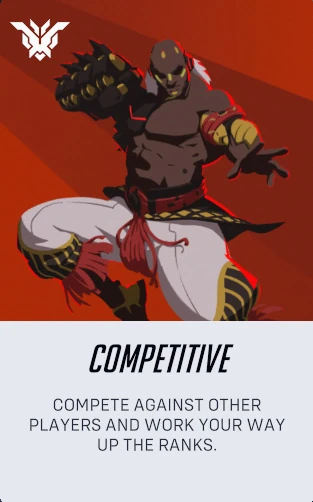
Competitive Play playlist card
| “ | Compete against other players and work your way up the ranks. | „ |
Competitive Play is the ranked playlist of Overwatch and Overwatch 2. Players must win 50 Quick Play (or Stadium, which grant double progress) matches or have owned Overwatch since before June of 2021 to unlock Competitive Play. In Competitive Play, players receive a rank representing their skill level, ranging from Bronze to the Top 500. As Competitive Play is meant to be a more serious game mode, it features altered rule sets and imposes some grouping restrictions for more fair and balanced matches. [1]
Game Modes
Permanent Modes
Competitive playlist features two permanent game modes: Competitive Play Role Queue and Competitive Play 6v6 Open Queue.
- Role Queue imposes a team composition 1 Tank, 2 Damage, and 2 Support heroes. Players must select a role they wish to play as in a match. Once a match has been found, they are only allowed to pick heroes in the role they selected for the entire match.
- 6v6 Open Queue does not restrict a team to have a specific number of damage or support heroes but limits the maximum number of tanks to two. Players can select a hero from any role and are allowed to switch roles during the match.
Open Queue ranking gives players 1 rank, whereas Role Queue gives players 3, one for each role.
6v6 hero changes
6v6 Open Queue modes have a slightly different balance state from 5v5 modes, with most changes going to heroes in the Tank role. The following table lists the balance changes made to heroes in the 6v6 modes. Otherwise, 6v6 modes receive the same balance changes as 5v5.
| Hero | Health changes | Armor changes | Shield changes | Ability changes |
|---|---|---|---|---|
 Ana |
|
|||
 D.Va |
Increased from 175 to 250. | Reduced from 325 to 300. |
|
|
 Domina |
Reduced from 400 to 375. |
|
||
 Doomfist |
Increased from 375 to 425. |
|
||
 Echo |
|
|||
 Hazard |
|
|||
 Junker Queen |
Increased from 375 to 450. |
|
||
 Juno |
|
|||
 Lúcio |
|
|||
 Mauga |
Increased from 425 to 450. | Reduced from 150 to 100. |
|
|
 Mizuki |
|
|||
 Orisa |
Increased from 150 to 250. | Reduced from 300 to 250. |
|
|
 Ramattra |
Increased from 275 to 350. |
|
||
 Reinhardt |
Increased from 250 to 325. | Reduced from 300 to 225. |
|
|
 Roadhog |
Increased from 600 to 650. |
|
||
|
||||
 Sigma |
Reduced from 275 to 250. |
|
||
 Winston |
Increased from 275 to 325. | Reduced from 200 to 200. |
|
|
 Wrecking Ball |
Increased from 300 to 450. | Reduced from 125 to 100. | Reduced from 150 to 0. |
|
 Zarya |
Increased from 175 to 225. |
|
||
 Zenyatta |
|


Temporary Modes
The playlist also features temporary game modes, such as Arcade-based modes available in a competitive setting. Temporary games modes are usually available for the latter half of the season, but may also stay longer.
Competitive Arcade Modes
Starting with Copa Lùcioball, introduced with the Summer Games 2017 event, Blizzard has sporadically added Competitive Arcade modes. The rewards for Competitive Arcade modes differ from those from the regular Competitive Play mode. As the seasons are shorter (as well as the matches duration), you earn fewer Competitive Points per match.
Following Arcade modes have been featured in Competitive play:
- Lúcioball
- Capture the Flag
- Elimination (6v6 and 3v3 Group)
- Deathmatch (8 player FFA and Team Deathmatch)
Mystery Heroes
Competitive Mystery Heroes was available during Seasons 3, 5, and 6 in Overwatch 2.
The rewards for game wins and the end of the season for Competitive Mystery Heroes are slightly lower than the Role Queue and Open Queue Competitive rewards. However, it is possible to earn both end of season rewards for Competitive Mystery Heroes and standard Competitive rewards in the same season.
Team Queue
Team Queue was a temporary competitive mode for Overwatch 2, lasting from Season 5 mid-season until the end of Season 5. It required everyone to play in a full group of five players. Team Queue had no ranking restrictions. Other important rules for the mode were:
- Players can group up regardless of how far apart they are in rank.
- Grandmaster players can play, even with up to four other Grandmaster players.
- Team Queue is limited to 1 Tank, 2 Damage, and 2 Support.
- Players do not queue for specific roles, instead choosing their roles within each match.
- Platform pool restrictions remain, meaning players on console must still only group up with other players on console, not those on PC.
Hero Bans
Hero bans were introduced in Season 16, allowing each team to ban up to two heroes, for a maximum of four bans total where a limit of two heroes per role is imposed. Before loading into a map, players have 15 seconds to select a preferred hero they wish to protect from bans. This selection is only a suggestion—teammates can still choose to ban preferred heroes. Afterward, players have 45 seconds to choose up to three heroes for banning, with the first choice weighted most heavily (7 votes), followed by the second (5 votes) and third (3 votes). Players may also opt to pass by pressing the Ready button. Each player’s preferred and ban choices are visible to the team, ordered left to right by priority. Ban selections can be changed until the timer runs out, after which players are presented with the final list of banned heroes for the match. In the case of a tie, the hero with more individual voters wins; if still tied, the decision is made randomly. Players can communicate with their team during the ban phase but cannot interact with the opposing team.
Competitive Ruleset
Compared to Quick Play, Escort, Hybrid and Push maps in Competitive Play feature different rulesets, but the rulesets in Control and Flashpoint maps are unchanged.
Push
- Match time is increased from 8 to 10 minutes.
Escort
- A minimum of 2 rounds are played, with both teams playing an attack and a defense round. Whichever team gets farther on their attack will win the match.
- If both teams manage to move the payload the exact same distance without reaching the final destination or fail to move it at all, the match ends in a draw.
- If both teams push the payload until the end, the match will proceed to extra rounds, following the time bank rules (see Extra Rounds & Time Bank).
Hybrid
- A Minimum of 2 rounds are played, with both teams playing an attack and a defense round. The attacking team which captures the most of the points and / or escorts the payload the farthest wins.
- If both teams fail to reach the first tick (1/3) on the capture point or manage to move the payload the exact same distance without reaching the destination, the match ends in a draw. Note if the capture point progress is between 33.3% (1st tick) and 100%, it is not possible for the game to end in a draw.
- If both teams capture the point and push the payload until the end, the match will proceed to extra rounds, following the time bank rules (see Extra Rounds & Time Bank).
Extra Rounds & Time Bank
If both teams complete the map in their first attacking round on a Hybrid or Escort map, extra rounds are played using the time bank system. No extra time is added when capturing checkpoints. When extra rounds start, the team with less time left attacks first. Time adjustments are made based on how much time each team has:
- If both teams have 120 seconds or more, the team with less time is set to 120 seconds, and the other team loses the same amount of time.
- Example: Team A has 165s and Team B has 250s. Team A drops to 120s (losing 45s), and Team B also loses 45s (ending with 205s).
- If the team with less time has between 60–119 seconds, no time changes are made to either team.
- If the team with less than 60 seconds has any time left (0.1–59.9 seconds), their time is bumped up to 60 seconds, and the other team gets the same amount added.
- Example: Team A has 20s and Team B has 150s. Both teams gain 40s, giving Team A 60s and Team B 190s.
- Hybrid only: If one team has no time left and the other has 60 seconds or more, only the team with time left plays. If they get at least 33.3% capture on Point A, they win. Otherwise, the match ends in a draw.
Ranks
Ranks are used to represent players' performance compared to other players in Competitive play. Since Season 9, a person's rank is the same as his matchmaking rating.[2][3] Players have a separate rank for Open Queue and for each role in Role Queue.
Skill Tiers & Divisions
The ranked system is split in nine tiers, and each tier in five divisions.[4] Additionally, the players position within each division is displayed as a percentage. Players can view their current skill tier and division through their Career Profile, or the Competitive Progress option in the Competitive Play menu.
Excluding Top 500, there are 5 divisions in each tier, with 1 being the highest and 5 being the lowest. The skill tiers from top to bottom are:
 Top 500
 Champion
1 - 5
Champion
1 - 5
 Grandmaster
1 - 5
Grandmaster
1 - 5
 Master
1 - 5
Master
1 - 5
 Diamond
1 - 5
Diamond
1 - 5
 Platinum
1 - 5
Platinum
1 - 5
 Gold
1 - 5
Gold
1 - 5
 Silver
1 - 5
Silver
1 - 5
 Bronze
1 - 5
Bronze
1 - 5
Top 500 Leaderboard
The Top 500 rank is given to players that have the 1st to 500th highest rating in their respective region (Americas. Asia, Europe) and platform (PC, PS4, XBox, Switch), and can be granted regardless of the player's actual skill tier and division. The current Top 500 can be viewed in the leaderboard, which can be accessed through the Competitive Play menu. Leaderboard and the Top 500 rank only becomes available two weeks after the start of a season, and to be eligible the player must have completed the "Seasoned Competitor" challenge, requiring 750 lifetime competitive wins, and have won at least 25 competitive matches in the current season. Blizzard SMS Protect must also be enabled for PC players.
Placement Matches
Starting from Season 9, the player must complete a set of 10 placements matches in order to gain a rank. Unlike previous seasons, it is not necessary to win these matches to progress the counter. The player's predicted rank is shown after each placement match before they gain their real rank.[5]
Rank Updates
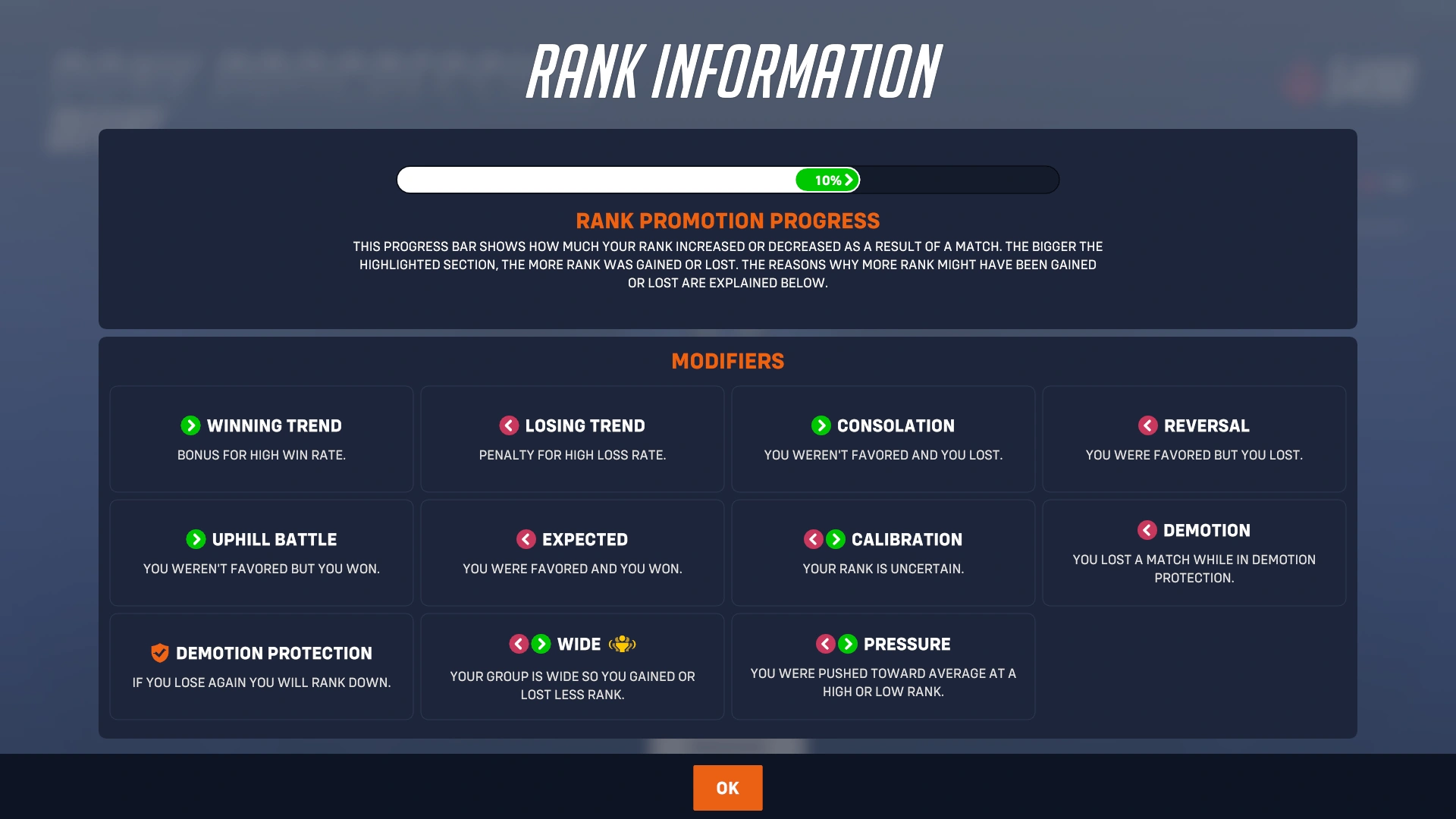

Explanation of rank modifiers in Rank Information screen
Players' ranks will update after every match. The rank updates are communicated to the players via the Rank Information screen, which displays how much their position in the division changed as a percentage, visualized by a progress bar towards the next division. Generally, players will gain rank progress whenever they win the match and lose progress whenever they lose. Rank Information also details what factors affected the amount of progress from the match with Rank Modifiers. Modifiers that have a positive effect, ie. cause the player to gain rank progress more upon win or lose less upon loss, are displayed with a green arrow to the right and ones with negative effect with a red arrow to the left.
Below is a list of the possible modifiers.
| Modifier | Effect | Description |
|---|---|---|
| Winning Trend |  |
Bonus for high win rate. |
| Losing Trend |  |
Penalty for high loss rate. |
| Consolation | |
You weren't favored[Note 1] and you lost. |
| Reversal | |
You were favored but you lost. |
| Uphill Battle | |
You weren't favored but you won. |
| Expected | |
You were favored and you won. |
| Calibration | |
Your rank is uncertain. |
| Demotion | |
You lost a match while in Demotion Protection.[Note 2] |
| Demotion Protection | If you lose again you will rank down. | |
| Wide | |
Your group is wide so you gained or lost less rank. |
| Pressure | |
You were pushed toward average at a high or low rank. |
| Notes: | ||
Demotion Protection
When player's Rank Progress would go below 0% and they would be demoted to a lower division, they will be put in "Demotion Protection", and instead of immediately ranking down a division, they will gain another chance and only rank down if they lose another match while in Demotion Protection.
When player enters Demotion Protection, the amount of Rank Progress that would go below 0% is not discarded, but will be saved and taken into account in the next rank update. Players can see this as negative Rank Progress in the Rank Update screen. If the player loses and is demoted, the next rank update will display this amount with a black bar, whereas the amount lost from the current match is displayed normally.
To leave Demotion Protection while retaining their current division, the player must again get their Rank Progress above 0%. In other words, if the player wins while in Demotion Protection, but does not gain enough rank progress to go back above 0%, they will remain in Demotion Protection for another match.
Inactivity
Players that did not play any matches during the previous competitive season will become Inactive. Inactive players do not have a visible Skill Tier and Division. Each role in Role Queue can become Inactive separately, while in Open Queue, a player only has one rank that can become Inactive. Once an Inactive player returns and achieves a Competitive Update after winning five games, their Skill Tier and Division will become visible again.
Distribution
Sometime after the start of Season 17, rank distribution was as follows:
| Rank | % of Playerbase |
|---|---|
| Champion
|
< 00.1 % |
| Grandmaster
|
00.3 % |
| Master
|
03.2 % |
| Diamond
|
14.9 % |
| Platinum
|
34.9 % |
| Gold
|
31.7 % |
| Silver
|
12.6 % |
| Bronze
|
02.4 % |
Per-Hero Skill Rating
Starting with Season 18, players can start gaining per-Hero SR to present their skill at individual heroes. The rules are outlined below:
- Per-Hero SR unlocks after completing 10 placement matches in Role Queue or Open Queue. This number is separate for both.
- A player needs to complete 5 hero placement matches until their SR unlocks. Their predicted SR can be viewed on the Competitive Overview screen and the Career Profile after playing at least one match.
- Top 3 heroes that are played for at least 3 minutes gain SR.
- Per-Hero SR is not used for matchmaking.
- Per-Hero SR reset every mid-year rank reset.
- SR values have a rank from Bronze to Champion attached to them. See below for values:
| Rank | SR (minimum-maximum) |
|---|---|
| Champion
|
4500-5000 SR |
| Grandmaster
|
4000-4499 SR |
| Master
|
3500-3999 SR |
| Diamond
|
3000-3499 SR |
| Platinum
|
2500-2999 SR |
| Gold
|
2000-2499 SR |
| Silver
|
1500-1999 SR |
| Bronze
|
< 1499 SR |
Groups in Competitive Play
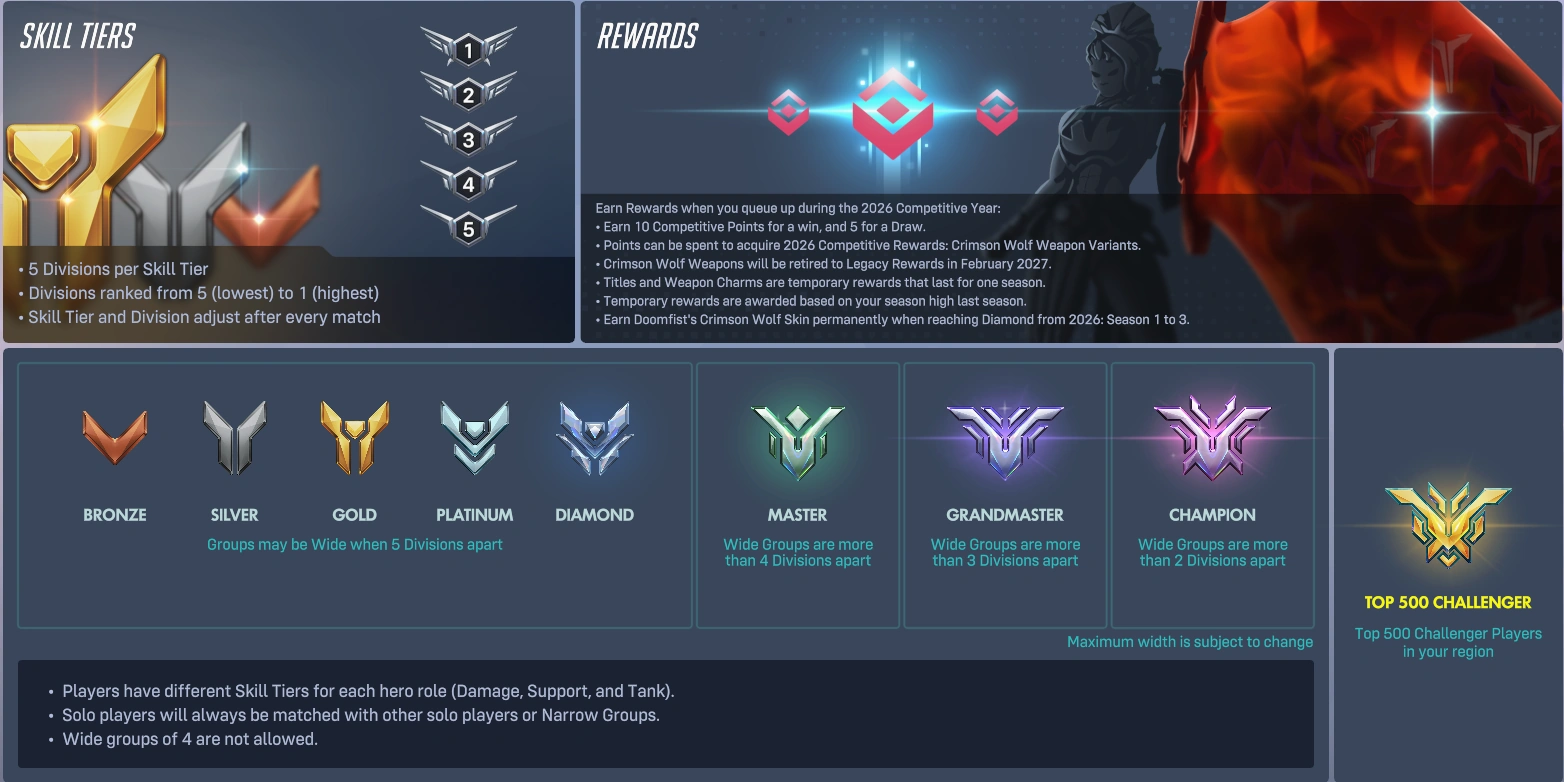

Competitive Wide Groups By Rank
Players are allowed to participate in Competitive Play as a group of any size and range of ranks, with some exceptions and tradeoffs. Groups are sorted into two categories: Wide groups and Narrow groups. Wide Groups are classified as groups with large rank disparity, while narrow groups are everything else. For Matchmaking, wide groups and narrow groups are matched separately, with solo queuers only ever being matched with narrow groups.
Wide Groups
Wide groups were introduced to allow friends who are ranks apart to play Competitive together. As such, wide groups consist of players with fairly large rank disparity. For Matchmaking, wide groups will only be matched against other wide groups and will still utilize Overwatch 2's Role Delta Tech to try match groups with similarly shaped groups to try keep gameplay as fair as possible[7]. Wide groups will receive the "Wide" modifier after each game to represent the decreased change in rank progress. Players will be informed prior to the match if the configuration of roles they have selected would result in a wide group.[8]
The following table describes what is considered a Wide Group at each rank.
| Rank(s) | Wide Group |
|---|---|
|
|
Highest and lowest ranked players are more than 5 Divisions apart. |
|
|
Highest and lowest ranked players are more than 4 Divisions apart. |
|
|
Highest and lowest ranked players are more than 3 Divisions apart. |
| Champion
|
Highest and lowest ranked players are more than 2 Division apart. |
The existence of wide groups results in a few tradeoffs: [8]
- Wide Groups have increased queue times and reduced match quality because it’s more difficult to find another group of players with the same ranks in the same roles to match against.
- Wide Groups of 4 players are unable to queue to ensure solo players never have to play a Wide Match.
- The wider your group, the less your Rank Progress will change with each win or loss.
- Wide groups are unable to queue for Competitive 6v6 Open Queue regardless of the number of players in the group.
Narrow Groups
A group is a narrow group when players in the group have little rank disparity, all being fairly close in rank. In other words, any group that does not fit the aforementioned wide group criteria is considered narrow. Narrow groups will be matched with other narrow groups and solo queuers.[7]
Penalties
- Main article: Penalties#Leaver penalties
As this mode exists to players wanting a more serious experience of Overwatch, harsher penalties are given to players who abandon their team before the end of the match. As opposed to Quick Play, players who exit a match from Competitive Play prematurely will not be able to join another game of any play mode until their original match is concluded, and departed players will not be backfilled. Players that fail to rejoin their match before it ends will automatically gain a loss, and have their future placement ranking lowered, as well as a temporary suspension from Competitive Play, with repeated offenses extending the duration of the suspension until an eventual permanent ban from the game mode. As such, it is ill-advised to play comp when you are short on time, or have a poor connection to the game.
Rewards
Competitive Points
- Main article: Competitive Points
Players can earn Competitive Points completing matches in Competitive Play: Each player is awarded  10 Competitive Points for a win, 5 for a draw or none for a loss. Additionally, each match completed fills the Competitive Progress meter, granting triple progress for wins. After completing 30 matches, the player gains an additional 100 Competitive Points.
Competitive Weapon Variants
- Main article: Weapon Variants
Season 9 introduced a new competitive reward system in which competitive seasons that span over a year will feature unique weapon variants that can be purchased with Competitive Points. At the end of the competitive season, the remaining Competitive Points are converted to Legacy Competitive Points and can be used to purchase weapons variants from previous seasons, such as Golden weapons. The 2024 season ran from February 2024 to January 2025 and featured Jade weapon variants as the competitive reward. The 2025 season runs from February 2025 to January 2026, featuring Galactic weapon variants as competitive rewards while Jade variants joined Golden weapons as purchasable with Legacy Competitive Points.
Competitive Titles
At the end of every regular season, the players ranked Gold and above gain a Player Title according to their skill tier at the end. Players can receive a competitive title for each role in the Role Queue as well as one for the Open Queue. Competitive titles can be used until the end of the season, after which they are replaced by the new reward title or removed, if the player has dropped below Gold rank.
Competitive Skin Rewards
In Season 18, Competitive Skin rewards were introduced, granted to any player who reaches Diamond or above. These skins are similar to the rewards granted from reaching higher ranks in Stadium. The first Competitive skin reward is Galactic Freja, obtainable between Seasons 18 through 20.
History
The mode has gone through extensive reworks since its launch and was further revamped 2 times in Overwatch 2.
Competitive Play seasons
| Overwatch | |||
|---|---|---|---|
| Season | Start Date | End Date | Notes |
| 1 | Jun 28, 2016 | Aug 17, 2016 | Had a 1-100 Skill Rating scale and a Sudden Death system if both teams reached their objective in the initial attack and defense rotation. During Sudden Death, one additional round was played where the attacking team was chosen by a coin flip. The attackers had to capture or escort the payload to the first point within 1 minute and 45 seconds. If they succeeded, the attacking team won the match. If they failed, the defending team won. |
| 2 | Sep 02, 2016 | Nov 24, 2016 | 1-100 Skill Rating scale expanded to a 1-5000 scale.
Sudden Death system replaced by the Time Bank system. |
| 3 | Dec 01, 2016 | Feb 21, 2017 | No Changes |
| 4 | Feb 28, 2017 | May 28, 2017 | |
| 5 | Jun 1, 2017 | Aug 28, 2017 | |
| 6 | Sep 1, 2017 | Oct 28, 2017 | Control map rounds reduced from a best-of-five to a best-of-three.
Duration of each competitive season reduced from three months to two months. |
| 7 | Nov 1, 2017 | Dec 29, 2017 | No Changes |
| 8 | Jan 1, 2018 | Feb 25, 2018 | |
| 9 | Feb 28, 2018 | Apr 28, 2018 | |
| 10 | May 1, 2018 | Jul 1, 2018 | |
| 11 | Jul 02, 2018 | Aug 28, 2018 | |
| 12 | Aug 31, 2018 | Oct 28, 2018 | |
| 13 | Nov 1, 2018 | Jan 1, 2019 | Off-season duration reduced from three days to two hours. |
| 14 | Jan 1, 2019 | Mar 1, 2019 | No Changes |
| 15 | Mar 1, 2019 | May 1, 2019 | Off-season removed. Henceforth the following season will begin immediately after the previous season ends. |
| 16 | May 1, 2019 | Jun 30, 2019 | No Changes |
| 17 | Jun 30, 2019 | Aug 13, 2019 | Ended two weeks early to implement a special three week season of Competitive Play that introduced the Role Queue system. Referred to as "Role Queue Beta" in player profiles to those that participated. |
| 18 | Sep 3, 2019 | Nov 7, 2019 | Role Queue system implemented with players having independent Skill Ratings for each of the three roles. Number of placement matches required decreased from 10 to 5. |
| 19 | Nov 9, 2019 | Jan 2, 2020 | Map pool system introduced. Each season had a specific selection of maps and only those maps were available for the entirety of the season.
Map pool:
|
| 20 | Jan 2, 2020 | Mar 5, 2020 | Map pool:
|
| 21 | Mar 5, 2020 | May 7, 2020 | Hero bans introduced, changing weekly. Banned heroes were chosen based on hero usage across all ranks. Map pools were removed on April 14th, 2020. Horizon Lunar Colony and Paris were removed from Competitive Play on the same day. Map pool (until April 14th):
Hero bans:
|
| 22 | May 7, 2020 | Jul 2, 2020 | Hero bans changed to be only applied to matches with an average team SR of 3500 or greater. Banned heroes were also chosen based on usage from the Overwatch League when the League was in season, and Grandmaster and Top 500 matches when not in season.
Hero bans were removed on June 8th, 2020. Hero bans:
|
| 23 | Jul 2, 2020 | Sep 3, 2020 | Open Queue system re-implemented as a separate Competitive Play mode from Role Queue. |
| 24 | Sep 3, 2020 | Nov 5, 2020 | No Changes |
| 25 | Nov 5, 2020 | Jan 7, 2021 | |
| 26 | Jan 7, 2021 | Mar 9, 2021 | |
| 27 | Mar 9, 2021 | May 6, 2021 | Season was delayed by five days due to technical issues. The original start date was March 4th, 2021. |
| 28 | May 6, 2021 | Jul 2, 2021 | No Changes |
| 29 | Jul 2, 2021 | Sep 2, 2021 | |
| 30 | Sep 2, 2021 | Nov 4, 2021 | |
| 31 | Nov 4, 2021 | Jan 6, 2022 | |
| 32 | Jan 6, 2022 | Mar 3, 2022 | |
| TBA | TBA | Oct 4, 2022 | Season was cut short for the release of Overwatch 2 and the shut down of Overwatch 1. Final season to grant comp points for each rank, as well as icons and sprays for the season and Top 500 rankings. |
| Overwatch 2 | |||
|---|---|---|---|
| Season | Start Date | End Date | Notes |
| 1 | Oct 4, 2022 | Dec 6, 2022 | Competitive was significantly reworked, with new placements, rewards and ranking system. A map pool is listed but does not actually apply in game. |
| 2 | Dec 6, 2022 | Feb 7, 2023 |
|
| 3 | Feb 7, 2023 | Apr 11, 2023 |
|
| 4 | Apr 11, 2023 | Jun 13, 2023 |
|
| 5 | Jun 13, 2023 | Aug 10, 2023 |
|
| 6 | Aug 10, 2023 | Oct 10, 2023 |
|
| 7 | Oct 10, 2023 | Dec 5, 2023 | No changes |
| 8 | Dec 5, 2023 | Feb 13, 2024 |
|
| 9 | Feb 13, 2024 | Apr 16, 2024 |
Major competitive update
|
| 10 | Apr 16, 2024 | Jun 20, 2024 |
|
| 11 | Jun 20, 2024 | Aug 20, 2024 |
|
| 12 | Aug 20, 2024 | Oct 15, 2024 |
|
| 13 | Oct 15, 2024 | Dec 10, 2024 |
|
| 14 | Dec 10, 2024 | Feb 18, 2025 |
No changes |
| 15 | Feb 18, 2025 | Apr 22, 2025 |
|
| 16 | Apr 22, 2025 | Jun 24, 2025 |
|
| 17 | Jun 24, 2025 | Aug 26, 2025 |
|
| 18 | Aug 26, 2025 | Oct 14, 2025 |
|
| 19 | Oct 14, 2025 | Dec 9, 2025 | No changes. |
Temporary game modes seasons
| Overwatch | |||
|---|---|---|---|
| Mode | Season | Dates | Notes |
| Copa Lúcioball | 1 | Aug. 2017 | Introduced with the Summer Games 2017 event. |
| Competitive CTF | 1 | Feb./Mar. 2018 | Introduced with the Lunar New Year 2018 event. |
| Competitive 6v6 Elimination | 1 | Apr./May 2018 | Was not part of an event. |
| Competitive Deathmatch | 1 | May/June 2018 | Introduced with the Anniversary 2018 event. |
| Competitive 3v3 Group Elimination | 1 | June/July 2018 | Was not part of an event. Introduced with the Looking For Group (LFG) feature.
You had to be in a group of 3 players to be able to queue for the mode. |
| Copa Lùcioball | 2 | Aug. 2018 | During the Summer Games 2018 event. |
| Competitive Team Deathmatch | 1 | Oct./Nov. 2018 | Was not part of an event. |
| Competitive CTF | 2 | Jan./Feb. 2019 | During the Lunar New Year 2019 event. |
| Competitive 6v6 Elimination | 2 | Mar./Apr. 2019 | Was not part of an event. |
| Competitive Deathmatch | 2 | June/July 2019 | Was not part of an event. |
| Copa Lùcioball | 3 | July/Aug. 2019 | During the Summer Games 2019 event. |
| Competitive 3v3 Elimination | 2 | Oct./Nov. 2019 | During the Halloween Terror 2019 event. |
| Competitive Team Deathmatch | 2 | Nov./Dec. 2019 | Was not part of an event. |
| Competitive CTF | 3 | Jan./Feb. 2020 | During the Lunar New Year 2020 event. |
| Competitive 6v6 Elimination | 3 | Mar./Apr. 2020 | During the Archives 2020 event. |
| Competitive Open Queue | 1 | Apr. 2020 | Was not part of an event. |
| Competitive Deathmatch | 3 | May/June 2020 | During the Anniversary 2020 event. |
| Competitive Open Queue | 2 | June/July 2020 | Was not part of an event. Is part of the main game now. |
| Competitive 3v3 Elimination | 3 | Sep./Oct. 2020 | Was not part of an event. |
| Competitive Team Deathmatch | 3 | Oct./Nov. 2020 | During the Halloween Terror 2020 event. |
| Overwatch 2 | |||
|---|---|---|---|
| Mode | Season | Dates | Notes |
| Competitive CTF | 2 | Jan./Feb. 2023 | Available for the latter half of Season 2. |
| Competitive Mystery Heroes | 3 | Mar. 2023 | Available for the latter half of Season 3. |
| Competitive Deathmatch | 4 | May 2023 | Available for the latter half of Season 4. |
| Competitive Mystery Heroes | 5 | June/July 2023 | Available for the whole Season 5. |
| Competitive Mystery Heroes | 5 | July 2023 | Available for the latter half of Season 5. |
| Competitive Mystery Heroes | 6 | Aug./Sep. 2023 | Available for the whole Season 6. |
Old grouping restrictions
Prior to Season 10, these were the previous grouping restrictions that had been in effect since Overwatch 2 released.
- Groups may only queue if all players in the group are within a certain range
- Players ranked Diamond and below can only group within 2 skill tiers (10 divisions) of each other.
- For example, a Bronze 5 player cannot play with a Gold 4 player.
- Master players may only group within 1 skill tier (5 divisions).
- Grandmaster and Champion players can only group within 3 divisions.
- Players ranked Diamond and below can only group within 2 skill tiers (10 divisions) of each other.
- Champion players may only queue solo or in a group consisting of two players.
- Players who have not completed their placement matches are unable to group with players ranked Diamond or higher.
Trivia
- In Custom Game only in Overwatch 2 Assault can be played with competitive rules. Players must capture both points to win the round. Point capture works like it does on Hybrid, with the rules for capturing the second point being identical to capturing the first (If players capture one point but capture none of the second, the enemy team can capture 1/3 or draw).
- Only 30 seconds of additional time will be added to the attacking team if they successfully capture the first control point in the extra rounds, unlike the 3 minutes given in the initial rounds.
References
- ↑ 2022-09-27, DEFENSE MATRIX ACTIVATED! FORTIFYING GAMEPLAY INTEGRITY AND POSITIVITY IN OVERWATCH 2. Play Overwatch, accessed on 2022-09-28
- ↑ 2026-04-21. The Official Systems Discussion (bit o' ranked) Spilo. Retrieved on 2026-05-17.
- ↑ 2024-11-25. Are Overwatch's Ranks Inflated? (Dev Interview) Spilo. Retrieved on 2026-05-17.
- ↑ 2022-09-28. Initializing systems! Updating Competitive play for Overwatch 2 Blizzard Entertainment. Retrieved on 2023-05-10.
- ↑ Blizzard Entertainment (2024-02-08). Revitalizing the Overwatch 2 Experience. Retrieved on February 28, 2024.
- ↑ Blizzard Entertainment (2025-07-18]). Weekly Recall: Meet Your Matchmaker.
- ↑ 7.0 7.1 2024-04-10, Developer Update | Competitive, Defense Matrix, & more. Youtube @PlayOverwatch, accessed on 2024-04-17
- ↑ 8.0 8.1 2024-04-16, OVERWATCH 2 RETAIL PATCH NOTES – APRIL 16, 2024. Blizzard Entertainment, accessed on 2024-04-17
External links
- Developer Update | Let's Talk Competitive Play
- Welcome to Competitive Play
- Overwatch 2 tier list for Season 16
| Playlists | |
|---|---|
| Maps | |
| Heroes | |
| Mechanics | |
| Systems & Content | |
| Other | |
| Removed features | |